
Search Oklahoma Sex Offenders
The Oklahoma sex offender registry is a public database run by the state Department of Corrections. You can search it to find registered sex offenders living, working, or attending school anywhere in Oklahoma. Each listing shows the person's photo, current address, offense history, and assigned risk level. The state uses a three-tier system to rank each registrant by the danger they may pose to the public. You can look up offenders by name, county, city, zip code, or by a set radius from any address. This page connects you to the state registry, local law enforcement contacts, and sex offender resources across all 77 Oklahoma counties and major cities.
Oklahoma Sex Offender Registry Overview
Oklahoma Department of Corrections Sex Offender Registry
The Oklahoma Department of Corrections runs the state sex offender registry through an online portal known as SORS. It is free to use and covers all 77 counties. The registry lists every person required to register under the Sex Offenders Registration Act, 57 O.S. 581 through 590.2. That law applies to anyone who lives, works, or attends school in Oklahoma and has been convicted of a qualifying sex crime after November 1, 1989. People who enter the state after that date with a prior out-of-state conviction must also register. The registry shows each person's photo, home address, offense type, and risk level. In some cases it also lists the name and phone number of the employer.
The DOC sex offender unit can be reached by phone at (405) 425-2607 or by email at osor@doc.state.ok.us. The office address is 400 Martin Luther King Avenue, Oklahoma City, OK 73111. Staff handle registry questions for any county in the state and can help with verification, address updates, and compliance questions.
The registry also lets you sign up for free email alerts through the Community Notification system. When a registered sex offender moves into your chosen area, you receive a notification. You can set alerts for any zip code or address in Oklahoma.
The Oklahoma sex offender registry portal is updated when offenders register or change their address. It is the primary source for all public sex offender information in the state.
The Oklahoma Department of Corrections sex offender registry portal is the main public-facing database for the state.
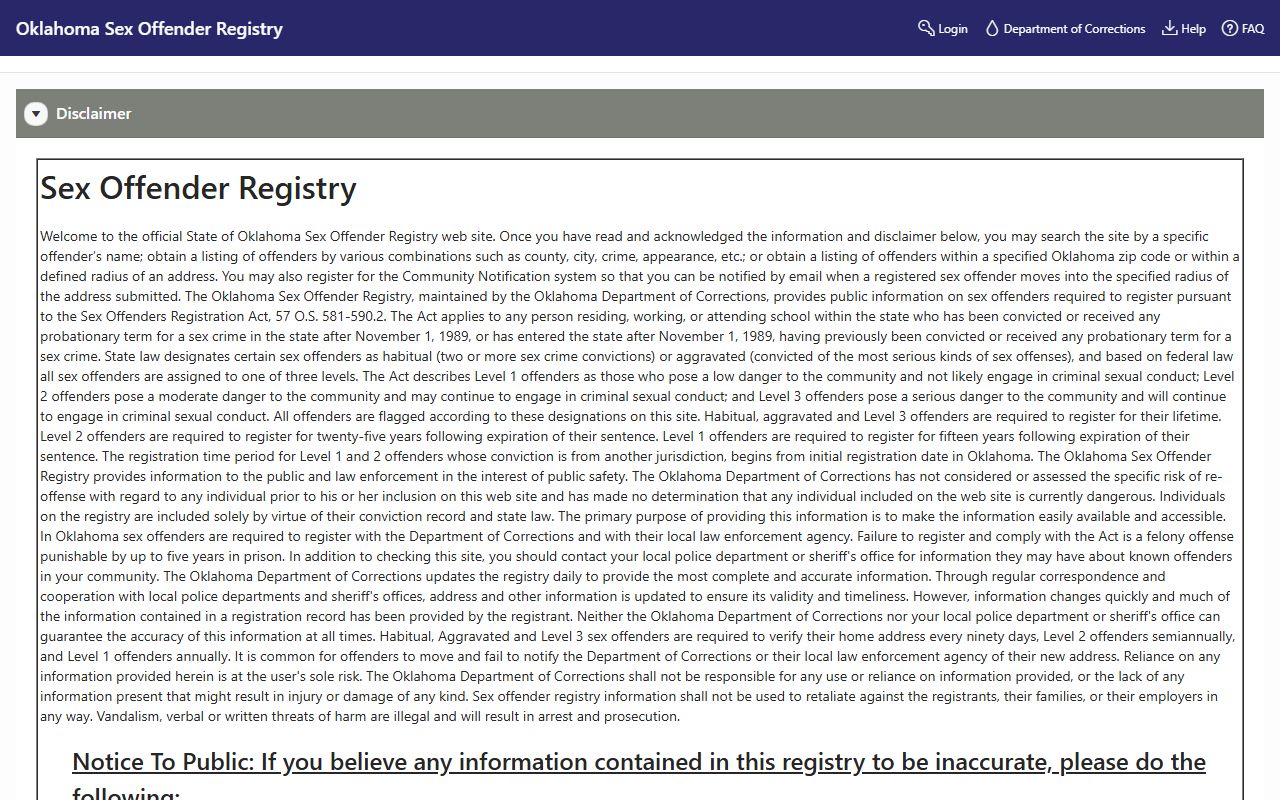
The portal allows name searches, county and city searches, zip code lookups, and radius searches from any Oklahoma address.
How to Search Oklahoma Sex Offenders
The state registry gives you several ways to find registered sex offenders in Oklahoma. Name search is the most direct method if you know who you are looking for. Location-based searches let you enter a county, city, or zip code and pull up a list of all registrants in that area. The radius option is useful if you want to see who is registered within a certain distance of a specific address. Results show each person's photo, current address, offense type, and assigned risk level.
The Oklahoma Attorney General's office provides supplemental guidance on using the registry at oklahoma.gov/oag. That page explains what information is available, who is required to register, and how the state handles registry data. It's a useful starting point if you are new to the registry or need background on how the system works.
The Oklahoma Sheriffs' Association also maintains information on sex offender registration statewide. The association directs users to the official DOC registry and explains how county sheriffs handle registration in their jurisdictions. Each of Oklahoma's 77 county sheriffs plays a role in enforcing registration requirements locally.
The Oklahoma Attorney General's office directs residents to the official state sex offender registry and explains access procedures.
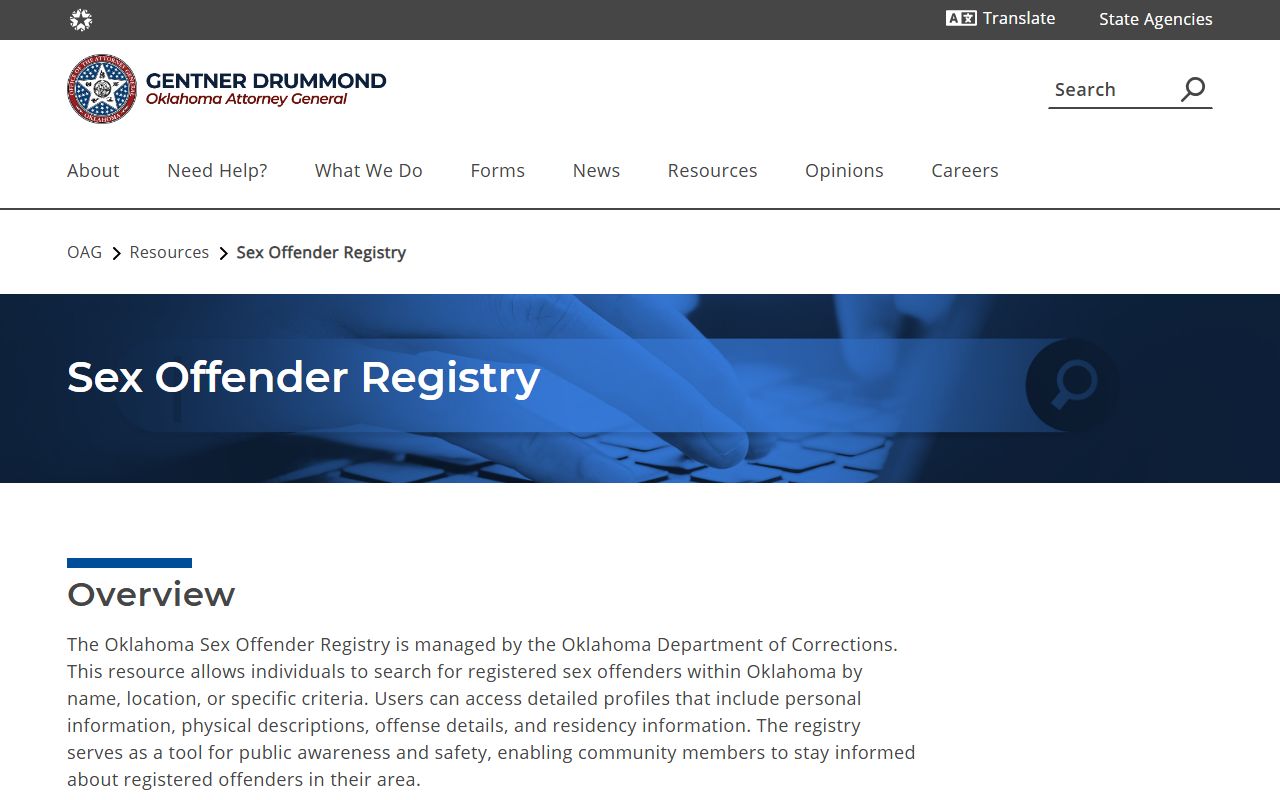
The AG resource page covers what the registry contains, who maintains it, and how to report suspected violations or non-compliance.
The federal government runs a separate national search tool at nsopw.gov. This is the National Sex Offender Public Website, operated by the U.S. Department of Justice. It pulls data from all 50 states, the District of Columbia, U.S. territories, and federally recognized tribal registries. You can search by name, city, county, zip code, or address radius. Oklahoma's data feeds directly into the national site, so you can search from either location.
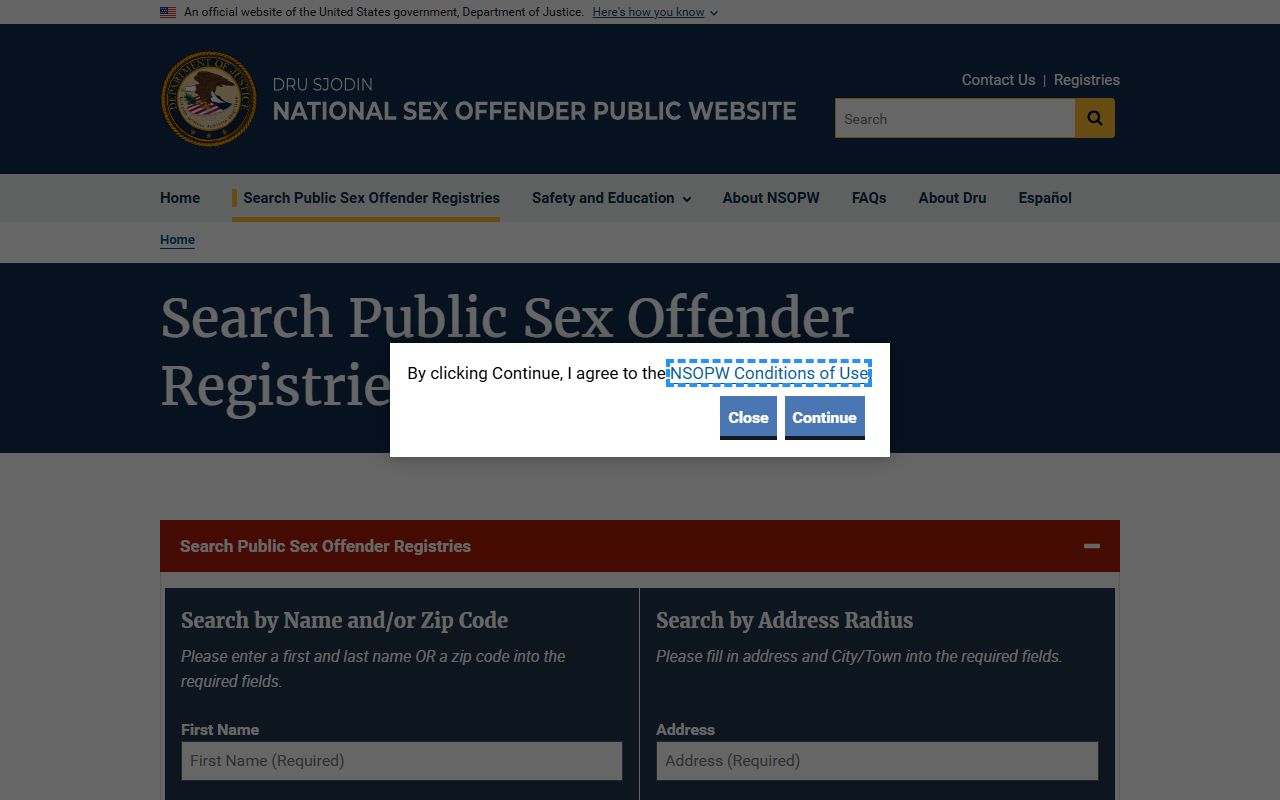
The national portal gives you access to Oklahoma sex offenders alongside data from every other state, which is helpful when an offender may have moved across state lines.
Note: Short delays may occur between when an offender updates their address and when the change appears on the public registry portal.
Oklahoma Sex Offender Risk Levels
Oklahoma assigns every registered sex offender a risk level when they first register. The level reflects their assessed danger to the community and the likelihood they will reoffend. Risk levels determine how often a person must verify their address and how long they stay on the registry.
Level 1 is the lowest tier. These offenders are considered unlikely to reoffend. They register once a year for 15 years from the date they complete their sentence. Level 2 is moderate risk. Those registrants verify their address every six months for 25 years. Level 3 is the highest risk for a single conviction. Level 3 sex offenders must verify every 90 days for life. Two categories sit above Level 3. Habitual offenders have two or more sex crime convictions. Aggravated offenders committed the most serious crimes listed in the Registration Act. Both groups register for life and verify every 90 days. These classifications appear on each offender's public profile in the state registry.
Oklahoma law also requires the DOC to mail non-forwardable verification forms to each registrant's last known address. The person must return the form in person within 10 days. If the form is not returned, law enforcement treats it as a possible address change and follows up.
Title 57 of the Oklahoma Statutes governs the entire registration system, including risk levels, verification schedules, and removal procedures.
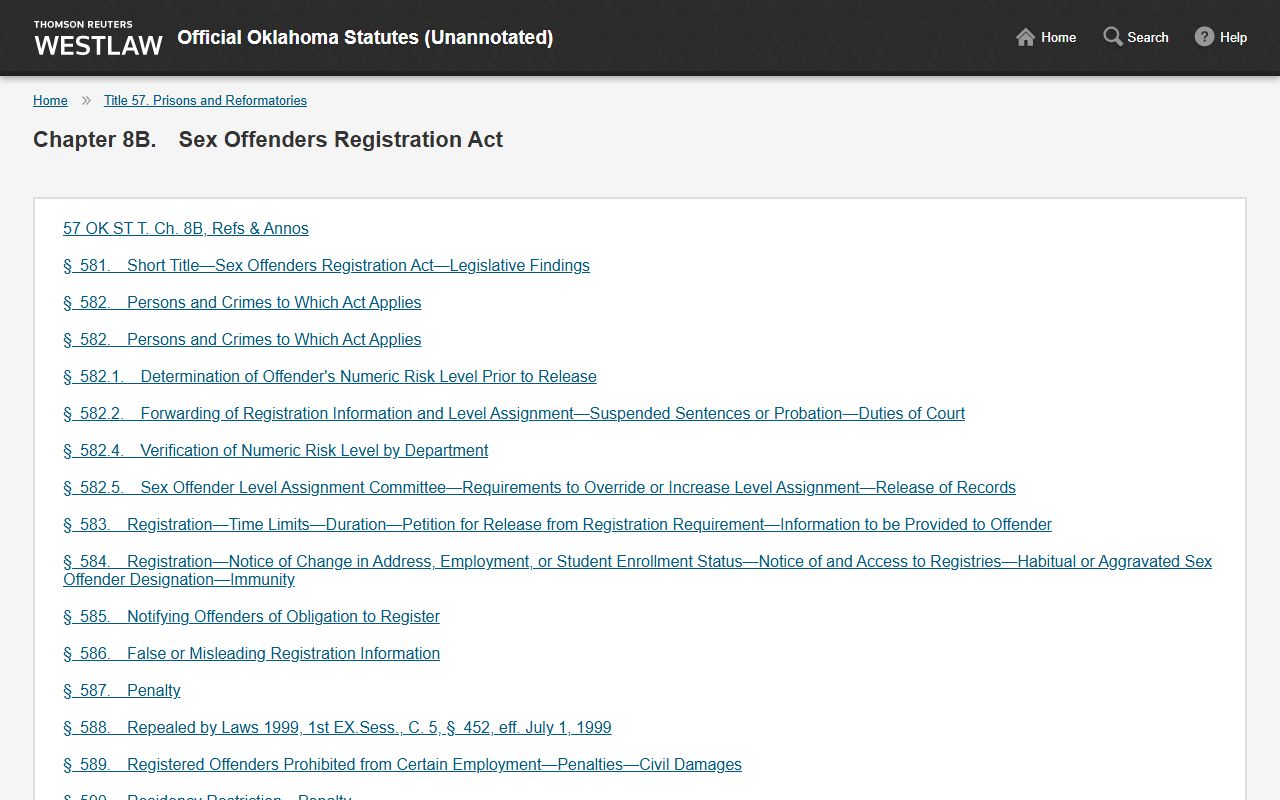
The Sex Offenders Registration Act in Title 57 sets out every requirement for registration, verification, and removal from the Oklahoma sex offender registry.
Sex Offender Residency Restrictions in Oklahoma
Oklahoma law prohibits registered sex offenders from living within 2,000 feet of certain protected locations. Under 57 O.S. § 590, the restricted sites include public and private schools, educational institutions, playgrounds, parks, licensed child care centers, family child care homes, and the home of any victim. The distance is measured in a straight line, often called "as the crow flies," a method in use since June 7, 2006. The measurement runs from the nearest property line to the nearest property line of the restricted site.
Offenders who plan to move must verify that the new address is not within a restricted zone before they relocate. Local law enforcement can check an address. Some Oklahoma cities have added local restrictions that go beyond state law. Lawton, for example, keeps an interactive safety zone map on its police website showing all prohibited areas within city limits. Only one apartment complex in Lawton currently falls within the permitted zone for registered sex offenders.
Oklahoma law does not set statewide employment distance restrictions for sex offenders, though individual probation or parole conditions may include such limits. Oklahoma also requires aggravated and habitual offenders to carry a state-issued ID or driver's license bearing the words "Sex Offender."
Oklahoma's restrictions are detailed in state law and cover residency limits, identification card requirements, and address verification schedules tied to each risk level.
Who Must Register as a Sex Offender in Oklahoma
Oklahoma's Sex Offenders Registration Act applies to people convicted of specific crimes listed in 57 O.S. § 582. Covered offenses include child sexual abuse, rape, rape by instrumentation, forcible sodomy under 21 O.S. § 888, lewd or indecent proposals to a child under 21 O.S. § 1123, indecent exposure under 21 O.S. § 1021, possession of child pornography under 21 O.S. § 1024.2, kidnapping involving sexual abuse, and incest. People who received a deferred judgment for these crimes must also register. The law treats a deferred judgment the same as a conviction for registration purposes.
People moving to Oklahoma from another state must register if they carry a prior qualifying conviction. Per 57 O.S. § 583, anyone who stays five or more consecutive days must register within two days of arriving. Working in Oklahoma for more than five cumulative days in a 60-day period also triggers registration. Students attending any Oklahoma school face the same requirement. They must provide a certified copy of their judgment and sentencing documents within 60 days of enrolling.
Transient individuals with no fixed address have additional obligations. Under 57 O.S. § 584, they must report in person to the nearest law enforcement office every seven days and provide information on where they have been staying. Failure to register is a felony in Oklahoma and can result in up to five years in prison.
The Oklahoma Supreme Court addressed how risk levels are applied in a key ruling on this topic.
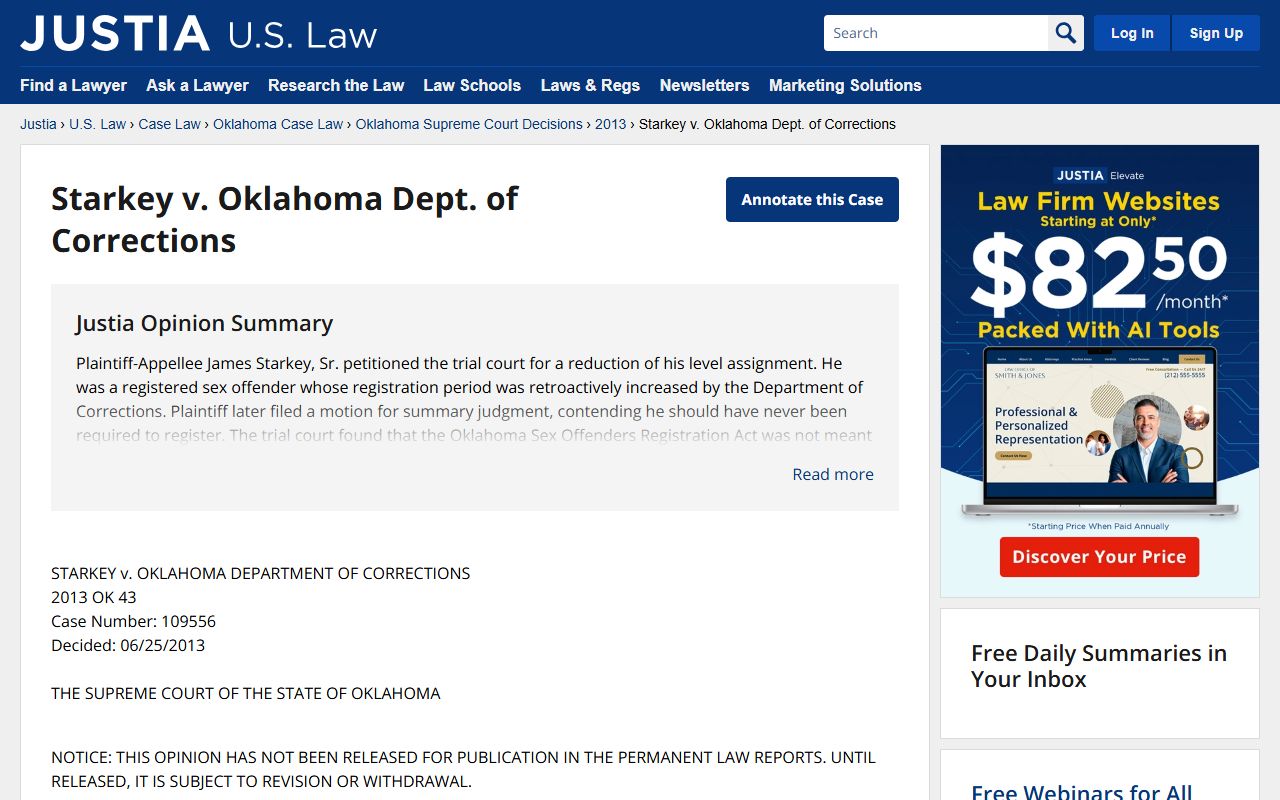
In Starkey v. Oklahoma Department of Corrections, the Oklahoma Supreme Court held that the 2007 amendments creating the three-tier risk level system apply prospectively, meaning the DOC cannot retroactively increase registration requirements for people already on the registry.
Tribal Sex Offender Registries in Oklahoma
Oklahoma has more federally recognized tribes than any other state, and many maintain their own sex offender registries. The federal Sex Offender Registration and Notification Act, known as SORNA, extended registration requirements to tribal jurisdictions through the Adam Walsh Child Protection and Safety Act of 2006. Each tribe must meet minimum federal standards and may add its own requirements. Tribal registries operate alongside the state DOC registry but are separate systems. They do not always list the same people.
The Cherokee Nation runs a tribal sex offender registry accessible through cherokee.nsopw.gov. Cherokee Nation jurisdiction covers much of northeastern Oklahoma, including parts of the Tulsa metro area. The Tulsa Police Department specifically recommends checking both the state registry and the Cherokee registry when searching for offenders in Tulsa, because the two can show different people for the same geographic area.
The Quapaw Tribe maintains its own registry at quapawnation.com in compliance with SORNA. The Comanche Nation in southwestern Oklahoma also operates a tribal portal at comanche.nsopw.gov. In areas where state and tribal jurisdiction overlap, some offenders must register with both systems. Anyone searching for sex offenders in tribal areas should check both the state and the relevant tribal registry.
The Cherokee Nation sex offender registry is accessible through the national NSOPW tribal portal.
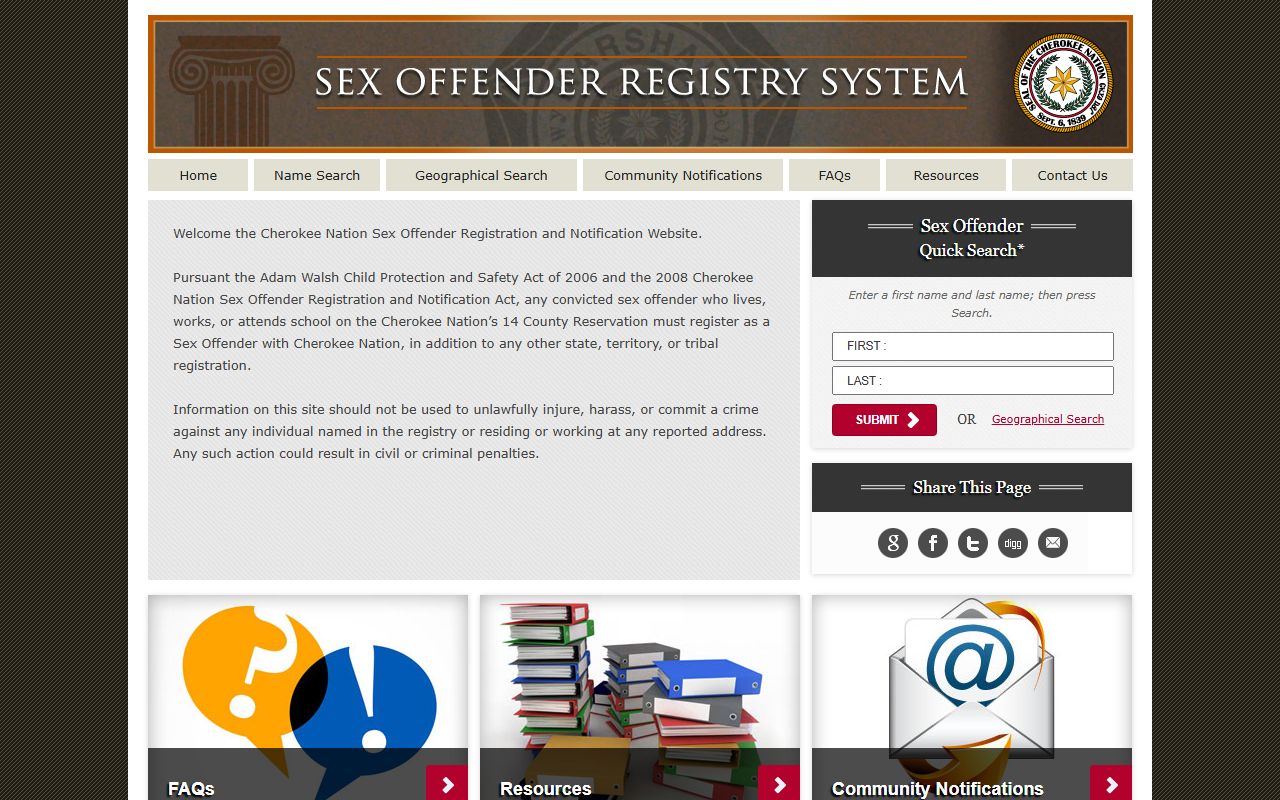
The Cherokee Nation registry covers offenders within the tribe's jurisdictional area and coordinates with both state and federal registration systems.
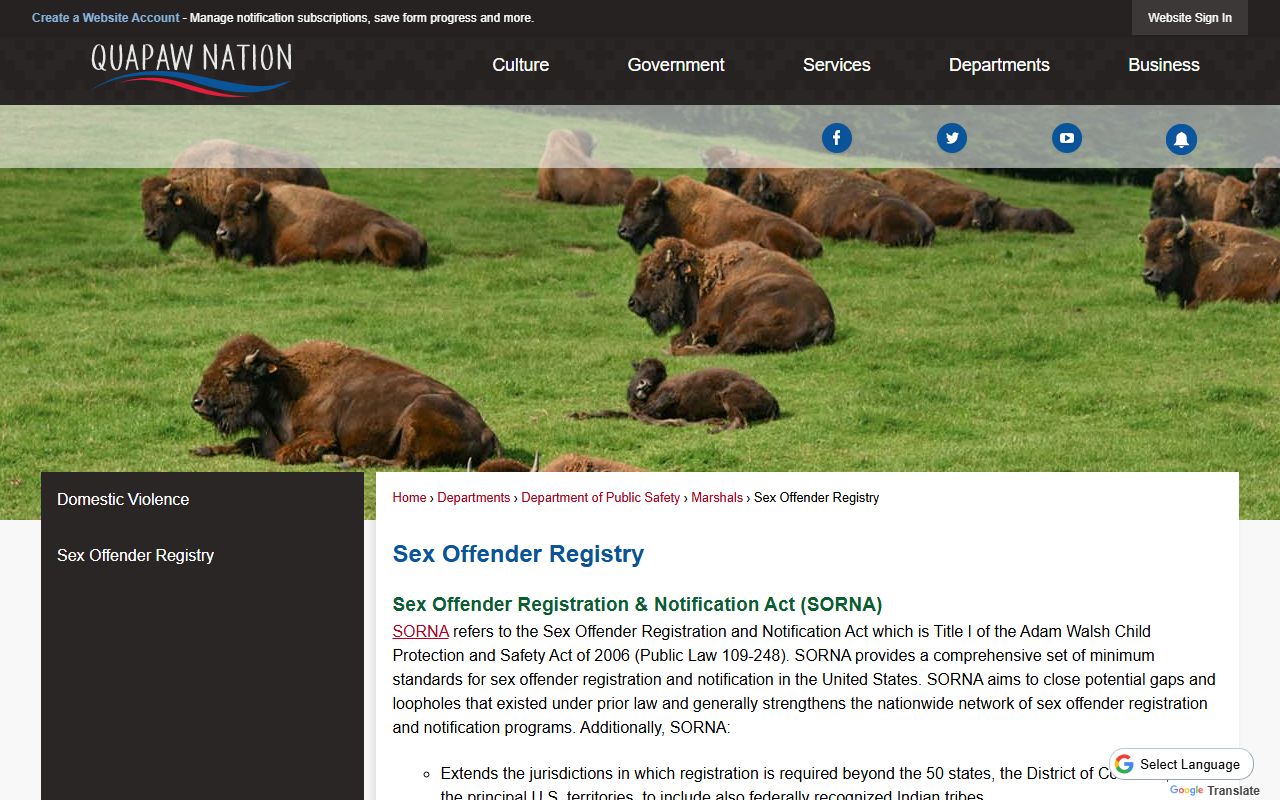
The Quapaw Tribe's registry is maintained in compliance with the Adam Walsh Act and integrates with the national sex offender public website for cross-system visibility.
Local Enforcement and OffenderWatch in Oklahoma
Many Oklahoma counties and cities use OffenderWatch, a platform that helps law enforcement agencies manage sex offender data in real time. When a registrant changes addresses, the system notifies participating agencies automatically. Residents can sign up for email alerts tied to any zip code or address they choose. Participating agencies in Oklahoma include the Tulsa County Sheriff's Office, Wagoner County Sheriff's Office, Pottawatomie County Sheriff's Office, Grady County Sheriff's Office, and several municipal police departments. The platform includes GIS mapping tools and a mobile app for public use.
The Tulsa Police Department provides a sex offender search page linking to four separate registries: the TPD local registry, the Oklahoma state registry, the Cherokee Nation registry, and the Muscogee Creek Nation registry. TPD recommends using all four systems for any Tulsa-area search, since tribal registries and the state system each cover different offenders for the same area.
The Lawton Police Department manages between 120 and 140 registered sex and violent offenders on any given day. New registrants must make appointments. Verification and homeless check-ins happen on Tuesdays and Thursdays from 8 a.m. to 3 p.m. Lawton also keeps an interactive map showing all areas where sex offenders are prohibited from living within city limits.
The Norman Police Department processes registrations at the Norman Investigations Center at 1507 W. Lindsey Street. Appointments are required and can be scheduled at 405-366-5237. NPD also investigates compliance violations and works with the Cleveland County District Attorney's Office to prosecute people who fail to register or verify as required.
The OffenderWatch platform connects multiple Oklahoma agencies for real-time data sharing, community alerts, and mapping of registered sex offenders.
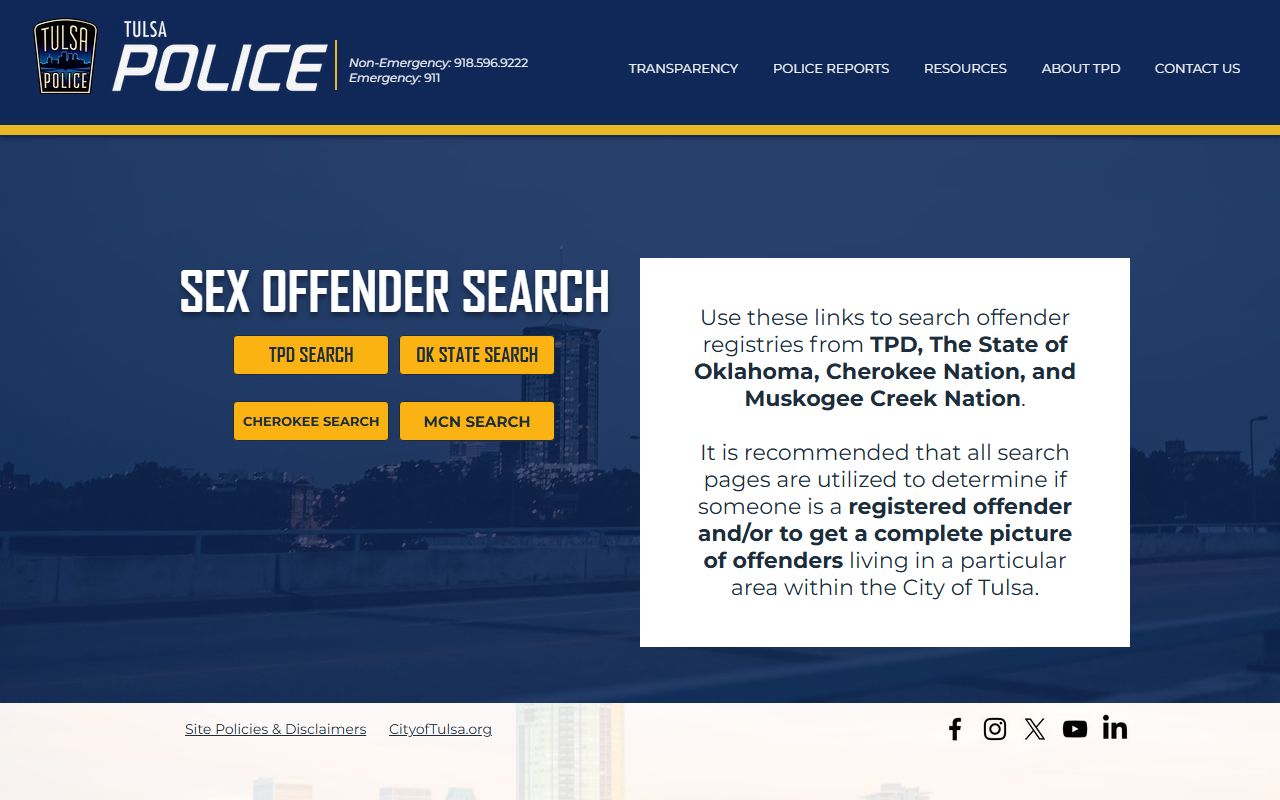
Tulsa PD's search portal reflects the city's overlap with Cherokee Nation and Muscogee Creek Nation jurisdictions, which each maintain separate sex offender databases.
Lawton's registry page includes a safety zone map that shows all restricted areas under the state's 2,000-foot residency restriction rule.
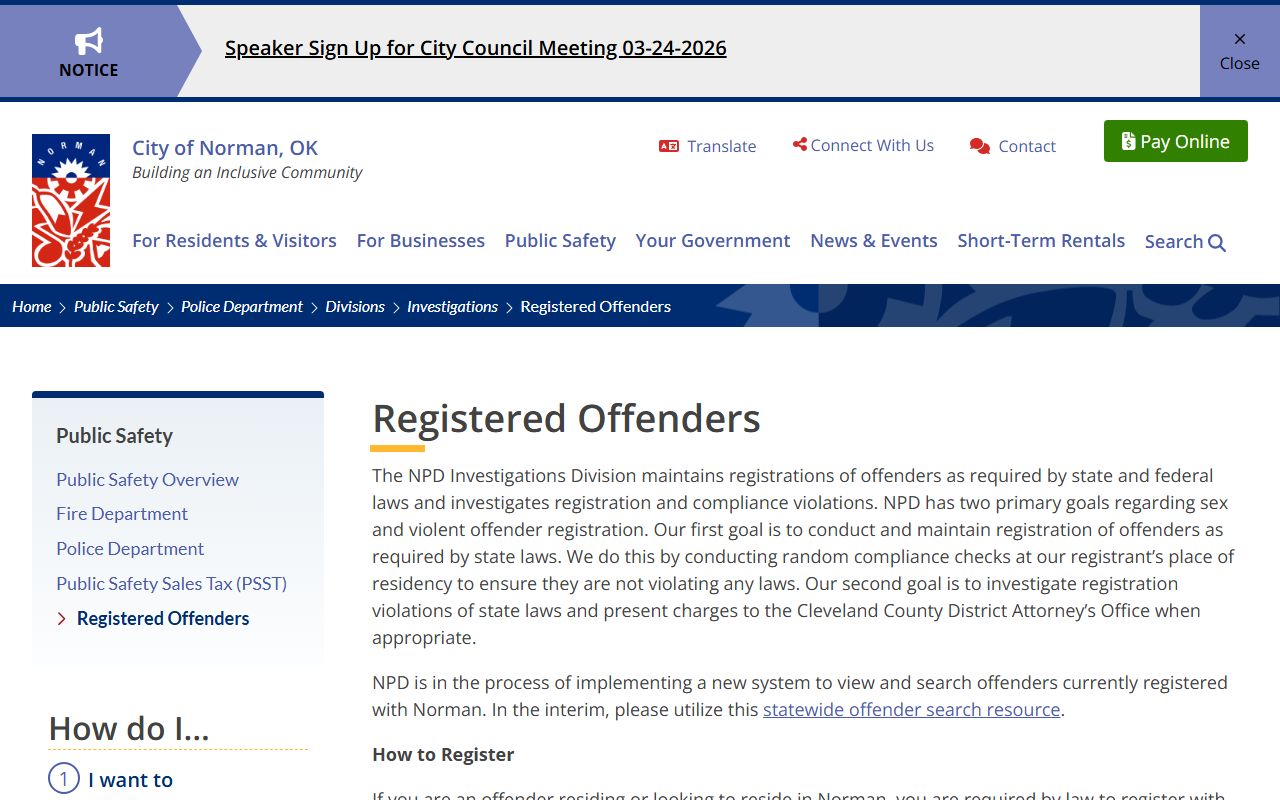
Norman PD's Investigations Division handles sex offender registration, runs compliance checks, and coordinates prosecution of registration violations with the county DA.
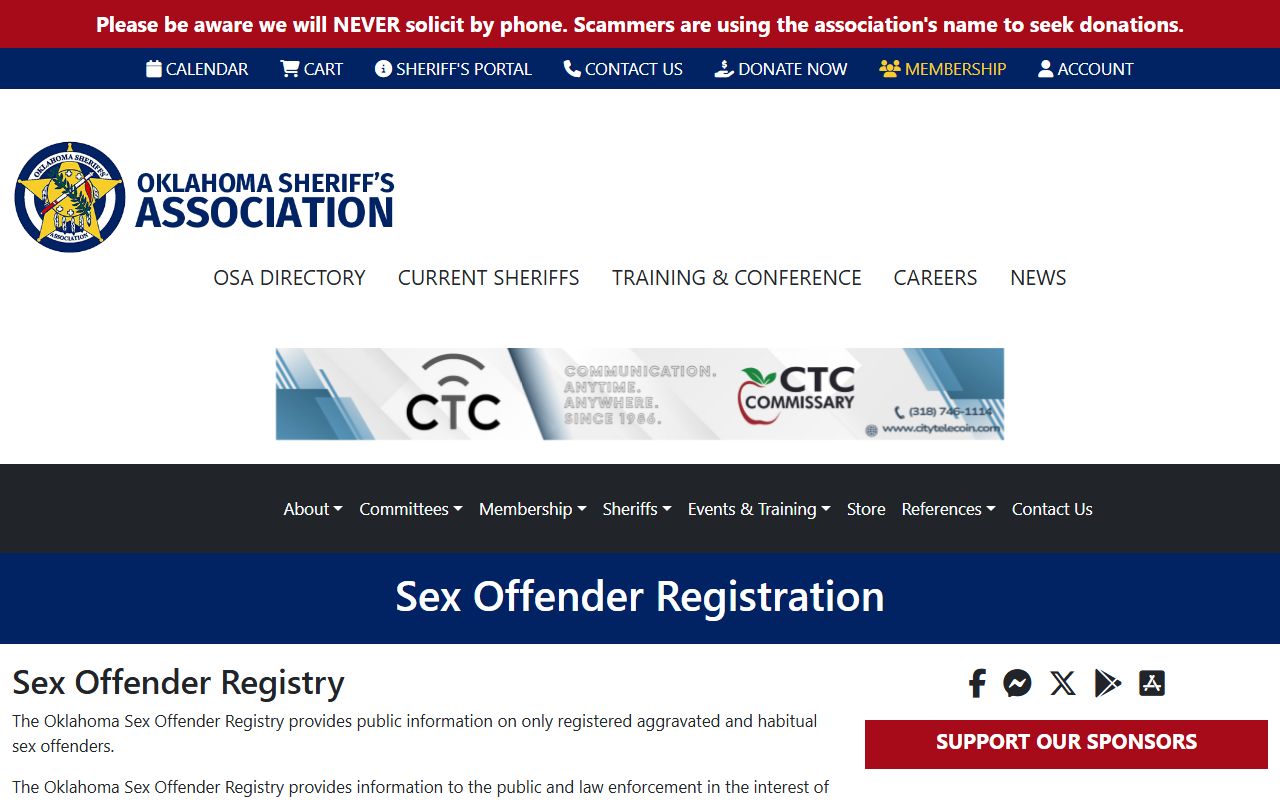
The Oklahoma Sheriffs' Association provides statewide registration information and connects residents with county sheriffs across all 77 Oklahoma counties.
Note: Some Oklahoma counties manage their own sex offender pages through their sheriff's websites in addition to the state registry, so checking both sources gives you the most complete local picture.
Browse Oklahoma Sex Offenders by County
Each of Oklahoma's 77 counties has its own sheriff's office that handles local sex offender registration. Select a county below to find registry resources, sheriff contact details, and local search tools for that area.
Oklahoma Sex Offenders by City
Major Oklahoma cities have local police departments that manage sex offender registration within city limits. Pick a city below to find local contacts, search tools, and registration resources.